


Introduction
Digital marketing encompasses a lot of different things, digital things, and SaaS also involves a lot of different things, sassy things. But how do you execute digital marketing working in or for a B2B SaaS company successfully? Well, in this guide we’ll talk through the most important parts of digital marketing in a B2B SaaS company.
Chapter 1: Digital Marketing for a B2B SaaS Companies
You can’t really do marketing without ‘digital’ today. The world has pretty much transitioned from offline to online. When the term ‘digital marketing’ was coined, there were lots of types of marketing, like event marketing, content marketing, partnerships marketing etc. But now nearly everything is digital marketing when you think of it, apart from giveaway stress balls, they are not digital, yet.
From my experience in marketing, digital marketers are often the ones in the engine room, making sure everything is ticking over and performing well, ready for an injection of content for fuel. That’s why when companies often have to make cuts, especially common in funded SaaS companies, digital marketing is usually one of the last roles to go, they keep the lights on for a lot of SaaS companies, and fuel their growth.
B2B SaaS is a big industry and that means there is a big opportunity. “Companies spend approximately $145 billion per year on B2B SaaS technology, and experts forecast a YoY (year-over-year) growth of 40% (Gartner)”.
Along with a great product, product market fit and an approach of product led growth (PLG), digital marketing helps B2B SaaS companies scale from boiler room operations to multi-billion dollar companies.
Digital marketing for VC backed startups
There is no greater test of your metal than working in digital marketing for a VC backed startup. Especially in the SaaS industry. Venture Capital firms invest heavily in SaaS companies. SaaS VC investment reached $94 billion spread across 4,459 deals in 2021.
Venture capital (VC) is a form of private equity and a type of financing that investors provide to startup companies and small businesses that are believed to have long-term growth potential.
Venture capital generally comes from well-off investors, investment banks, and any other financial institutions. Venture capital doesn't always have to be money. In fact, it often comes as technical or managerial expertise. VC is typically allocated to small companies with exceptional growth potential or to those that grow quickly and appear poised to continue to expand.
The thing with a VC backed company is that their investment expects a return. This means hitting growth targets, which are basically revenue targets. This is all fine when you hit the targets, but if you don’t this is when things can unravel fast.
As a digital marketer, one of your main objectives is to generate revenue through your website, so you are really at the heart of growth when it comes to growing a SaaS business. It’s therefore important to have a playbook of strategies and tactics you can utilise.
Learning on the job as a digital marketer can be brutal and a lot of time you will also be assisted by the product you are marketing, making your life a lot easier or harder.
How to choose a B2B SaaS company
Not all B2B SaaS businesses have great products and/or employees. No matter how good you are at digital marketing, if the product and the product-market-fit are poor, the company will struggle no matter what.
So how do you go about choosing the right SaaS company to join? I can give you a few pointers here based on my experience;
- Pick a product led business, rather than sales led
- Look for an experience marketing team
- Look out for high turnover
- Check Glassdoor reviews
- Review their funding rounds on Crunchbase
All this said, you can never really know what is going to happen when you join a company. There are so many variables to consider, the macro-economy being one of the most important ones, and no company can control that. You can look out for a few things during your interview process and think about these common reasons why B2B SaaS companies fail and ask yourself do any of these ring true for the company?
- Lack of Market Fit
- Insufficient Validation and Research
- Poor Product-Market Strategy
- Weak Customer Acquisition and Retention
- Inadequate Financial Management
- Lack of Scalability and Technical Challenges
- Ineffective Leadership and Team Dynamics
- Competitive Landscape and Industry Dynamics
Stages to join a SaaS company at
Your experience in working in a company massively depends on the stage you join them at. For example, joining a B2B SaaS company like HubSpot that is now a large company with many employees is very different to joining them when they were just starting out in 2005/2006.
Early Start-up Stage
The benefits of joining a company early are usually better stock options and growth potential. The downsides are that it is often scrappy, not as well-paid and can be frustrating at times as everyone is figuring out a lot of different things.
Growth/investment Stage
On the other hand, joining a company during the growth stage is probably the most common scenario, mainly because this is when companies are on a hiring drive after getting funding. At this stage there are still decent stock and equity options but by this point they have been severely diluted by investors and the fact that you weren’t there at the beginning.
The benefits of joining at the growth stage is that you will typically have the investment you need to grow and do what you need to do. This is often the thing missing at the start-up stage which makes it hard, money.
Late Stage/Exit or Buyout
This is the last stage to join a company, this is the point where they have ‘made it’ if you will. At this point they are a solid, stable company, perhaps they were acquired or perhaps they IPO’d on the stock exchange? This can be a tricky stage, especially if the company is acquired.
Chapter 2: Digital Strategies for B2B SaaS
Once you are working in a B2B SaaS company, you will have to decide which strategies and tactics to implement. Strategy choice depends on the audience you are trying to reach. This is because the cost per lead, opportunity and the total cost of acquisition are important metrics that help dictate the money you can spend on acquisition, and in turn that will dictate your strategy.
Introducing CAC & CLTV
Customer Acquisition Cost (CAC) and Customer Lifetime Value (CLTV) are two important metrics to assess when devising a digital marketing strategy for a B2B SaaS. This is because these metrics can dictate your investment, which directly impacts your available strategies.
The CAC represents the cost incurred to acquire a new customer, while CLTV measures the total value a customer brings to the business over their entire lifetime. By comparing CAC to CLTV, you can determine whether your customer acquisition efforts are generating enough value to justify the cost.
Ideally, the CLTV should be significantly higher than the CAC. This indicates that the revenue generated from a customer throughout their lifetime exceeds the cost of acquiring that customer. A healthy CAC-to-LTV ratio is typically considered to be 3:1 or higher, meaning that the customer generates at least three times their acquisition cost in lifetime value.
If the CAC is higher than the CLTV, it suggests that the cost of acquiring customers outweighs the value they bring, which can result in unsustainable business economics. In such cases, it may be necessary to reassess customer acquisition strategies, optimise marketing and sales efforts, improve customer retention, or explore opportunities for increasing customer lifetime value.
Tracking and analysing the correlation between CAC and CLTV can help direct your digital marketing strategies to ensure the return on investment (ROI) is working favourably for the money spent on digital marketing.
Problems with relying on CAC
Because CAC encompasses all costs associated with acquisition such as marketing spend and sales spend + salaries, as a digital marketing professional you may not have access to some of these figures, and besides that, some B2B SaaS companies don’t use this metric or track it enough or share it with so you won't be able to use it.
There are also factors that can compromise the accuracy or reliability of the Customer Acquisition Cost (CAC) metric in a B2B SaaS company including being able to attribute clients to certain channels, timing and overlapping efforts, not too mention incomplete data.
You can mitigate these challenges and improve the accuracy of CAC by establishing clear tracking mechanisms, investing in reliable data systems, and regularly review and refine the attribution models used for calculating CAC.
Using Cost Per Lead (CPL) Instead of CAC
Because CAC can be a bit more difficult to measure, and also it requires more information from a top business level to be able to measure it correctly, Cost Per Lead(CPL) is a simpler metric to not only measure, but it is a good leading indicator to CAC and you can measure it in a few different ways, at different levels of lead qualification.
- Cost Per Lead
- Cost Per Qualified Lead
- Cost Per Opportunity
How to use data to estimate cost per lead benchmarks
If we can assume the lifecycle stages of a contact go as follows:
- Contact
- Lead
- Qualified Lead
- Opportunities
- Acquisitions (Customers)
We can use some sample data to estimate the cost for generating contacts at each stage of the customer acquisition funnel, including estimated conversion rates from one stage to the next. We'll assume a quarterly period for this example.
- Contacts: $100 per contact (500 contacts)
- Leads: $5,000 (50 leads)
- Qualified Leads: $1,500 (15 qualified leads)
- Opportunities: $300 (3 opportunities)
- Acquisitions: $90,000 (1 acquisition)
These estimates provide a general understanding of the cost associated with generating contacts at each stage of the customer acquisition funnel.
Whether or not these metrics are favourable will depend on the average customer lifetime value. Because if the cost of acquisition for one client is $90,000 and the lifetime value of that client is $90,000 that is a 1:1 ratio and not a financially viable path to growth. On the other hand if that lifetime value is $300,000 then the ratio is more like 3:1 and it is a much healthier metric.
Different Digital Strategies for Different CLTV Values
Really what it comes down to for a B2B SaaS digital marketer is, what strategies do you deploy for the different values of Customer Lifetime Value.
Using common sense you can understand that the investment for one customer with an average lifetime value of $200,000 will be different to one of $20,000.
Bring this into the practical word of digital advertising. You can start to analyse the cost per click and cost per conversion and see if this equates to
B2B SaaS Strategy for Enterprise (Large CLTV)
For enterprise products, where you are targeting larger organisations with large budgets, a B2B SaaS strategy needs to shift more towards sales enablement and account based marketing. This needs the digital marketing tactics to be in lockstep with sales. This can mean micro-sites for accounts, using ZoomInfo intent data solutions or equivalent and investing
B2B SaaS Strategy for Mid-market (Medium CLTV)
The mid-market is sometimes the hardest type of company to target. There is often the greatest danger of leaning too close to SME strategies or the other way to Enterprise strategies, the danger being you either under invest or over-invest.
B2B SaaS Strategy for SME Businesses (Small CLTV)
Targeting SME usually involves a larger market and a lower cost per conversion and acquisition. With SMEs and B2B marketing you can start to swing your strategy more towards B2C type strategies, this is because, as an example, if you sell software like Tide Business Banking, you are also targeting Sole Traders and people setting up their own business, these are individuals, so it is really a B2C strategy.
Chapter 3: Inbound marketing for B2B SaaS
One strategy that works for all sizes of deals is inbound marketing. It’s one of the most widely used strategies to grow a B2B SaaS company, which is why it gets its own chapter. This is because it is a somewhat organic approach to growth and can cost less than some other strategies that rely more heavily on investment.
The idea of ‘inbound’ is that you attract people to your brand and then nurture them all the way through the buying process and beyond, ending up with customers who refer you to other potential customers, this generates a virtuous circle for growth.
Inbound vs Outbound marketing
Inbound marketing is focused on attracting customers to your business when they are actively looking for something, outbound marketing is focused on approaching your target audience whether they are looking for information or not.
What does Inbound marketing involve?
Inbound marketing can include a variety of different marketing tactics and techniques, and new ones are emerging over time as technology advances and so does consumer behaviour. However, these are currently the most popular activities involved in inbound marketing:
- Search Engine Optimisation
- Search Engine Advertising
- Social Media Marketing
- Paid Social Advertising
- Content Marketing
- Email Marketing
5 B2B SaaS Inbound Marketing Hacks
Ok so knowing inbound marketing is great doesn’t mean it's going to do the work for you.Based on our experience these are some of the hacks we have discovered over the years that have served us well.
1. Use Capterra to find your software categories
First things first, what categories does your B2B SaaS software fit into? And there will be multiple categories, you can use software comparison and review websites like G2 and Capterra to see which categories you fit into. This is important for everything that follows.
2. Use ChatGPT to find keywords for free
If you don’t want to invest in some SEO software to do keyword research you can use ChatGPT to find keywords for free. As a large language model, ChatGPT is a great tool for finding relevant keywords.
3. Create “What is” blogs for each category
So this isn’t that sophisticated but it's a good starting point. If you imagine you are teaching your audience from start to finish what something is, you have to start with the basics, that means explaining what someone is.
4. Create a landing page for each category
Once you know which categories your software falls into, you should create a landing page for each of those categories.
5. Look for software specific keywords
When you are conducting keyword research for SEO and/or PPC. Look for words related to software, examples would be systems, apps, solutions. If you get your keywords into a Google Sheet you can use a REGEX match.
Using AI for educational content creation
One thing that you should consider is using AI tools like ChatGPT for its educational content creation. This is content that is created in order to inform your audience about a topic. This is different from creating opinion pieces and thought leadership, that should always come from you as a company. That’s the chance to provide your take on something.
For educational purposes on the other hand, AI is probably better than most humans at producing educational content because it has a much wider data-set to use to write that content. Also with educational content, people are looking for the information, not your opinions. So in this scenario you should utilise AI to churn out useful information quickly, this also helps your SEO.

Chapter 4: B2B SaaS Marketing Maturity Index
The B2B SaaS Marketing Maturity Index is a framework used to assess the level of maturity and effectiveness of a B2B SaaS company's marketing efforts. It provides a structured way to evaluate various aspects of a company's marketing strategies, tactics, and capabilities.
The aim of the index is to help identify your strengths, weaknesses, and areas for improvement, enabling you to prioritise their marketing initiatives and drive better results.
The specific components and criteria included in the B2B SaaS Marketing Maturity Index can vary depending on the source or company using it. However, here are the ones in our digital marketing maturity index:
- Branding and Positioning
- Analytics & Attribution
- Performance Marketing
- Website
- Marketing Technology
By evaluating these aspects and assigning scores or ratings, the B2B SaaS Marketing Maturity Index provides a comprehensive view of a company's marketing maturity level. It helps identify gaps, prioritise areas for improvement, and establish a roadmap for enhancing marketing capabilities to drive business growth.
The Stages of Digital Marketing Maturity
A maturity matrix, also known as a capability maturity model or maturity model, is a framework used to assess and improve the maturity of a process, system, or company. While specific maturity models may vary, there are typically five common stages or levels within a maturity matrix. These stages represent progressively higher levels of maturity and capability. Here is a general overview of the stages commonly found in maturity models:
Stage 1: Ad hoc
This is the starting point where processes are often chaotic, undocumented, and inconsistent. There is a lack of standardisation, and activities are typically reactive and driven by individuals rather than established procedures.
Stage 2: Repeatable/Managed
At this stage, companies begin to introduce some level of consistency and structure to their processes. Basic procedures and guidelines are established and followed. The emphasis is on documentation, planning, and ensuring that processes are repeatable.
Stage 3: Defined/Standardised
In this stage, companies have well-defined processes that are documented, communicated, and followed consistently across the company. There is a focus on establishing standard practices, templates, and guidelines. Processes are tailored to meet specific needs and are continuously improved based on feedback and lessons learned.
Stage 4: Quantitatively Managed:
At this stage, organisations start to collect and analyse quantitative data to manage and improve their processes. Key performance indicators (KPIs) and metrics are established to measure process performance and make data-driven decisions. The emphasis is on continuous monitoring, analysis, and improvement of processes to achieve predictable outcomes.
Stage 5: Optimising/Continuous Improvement:
This is the highest level of maturity, where organisations strive for continuous improvement and innovation. There is a culture of learning and experimentation, and processes are regularly evaluated and refined. The focus is on proactively identifying opportunities for improvement, adopting best practices, and driving innovation to stay ahead of the competition.
Chapter 5: A B2B SaaS MarTech Stack
Wow, there are a lot of acronyms in that header, sorry! Marketing technology (MarTech) is essential for the success of a B2B SaaS company.
It can be difficult figuring out which technology to use when you are starting out, it doesn’t help that new marketing tech is released every year, promising bigger and better things. Often, as marketers you will end up with the fear of missing out on some new tech that is going to catapult your efficiency and growth.
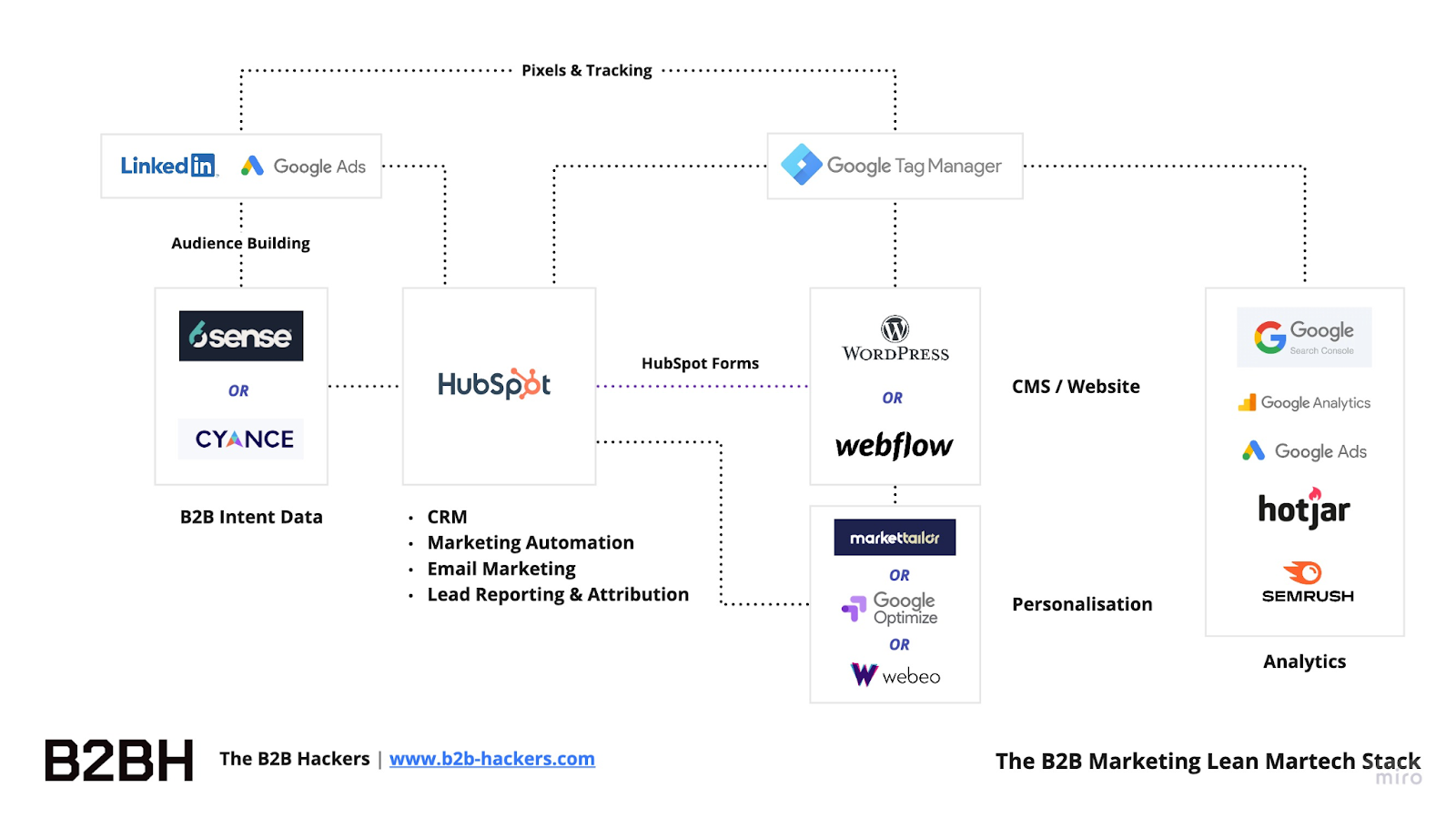
From my experience, the analogy of an athlete with all the gear but poor training practices is a great way to summarise a lot of B2B SaaS marketing tech stacks. I’ve found it is best to start simple, build strong practices and processes with some core tools and then expand on that as the business grows and requires more complex functionality, such as intent data etc.
In fact in this article I talk about a lean marketing tech stack that is a great way to set up your B2B SaaS martech.
B2B SaaS Website Strategy
The website is perhaps the most important digital asset you will be managing. For a SaaS company, the website is almost part of the product itself and it is usually the main gateway for people to sign-up for your software.
There are some key components to consider when designing and launching a website for a B2B SaaS company. Of course, if you are employing an agency to build your website for you, then they will be able to advise you on some if not all of these elements.
The thing about a website for B2B SaaS is that it follows a certain design pattern, most of them have the same underlying architecture and strategy. There is a reason for this, it’s because it works for Inbound Marketing and especially for SEO.
The framework below shows how most growing B2B SaaS companies create a landing page for every potential search query. The reason this works is because people all search based on different priorities, some look for a specific feature or integration and some look for a well known solution term like “project management software”. Others also look for industry specific solutions such as “project management software for agencies”.
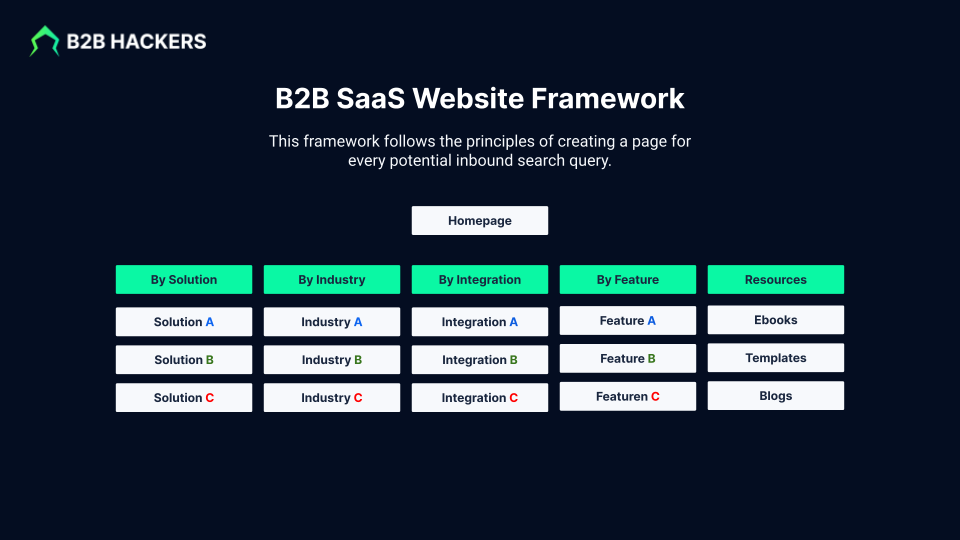
The only time a company steps away from the normal framework is when they have grown big enough by reputation that they no longer need to focus on generating net new traffic from unbranded search terms. For a growing company though, you should follow the proven framework.
Reducing friction
The other main principle of a successful B2B SaaS website is that you should always try to reduce the ‘friction’ or the effort it takes for someone to take action, in most cases that means to sign-up for the software.
To do this you should try and do a couple of things:
- Reduce the number of clicks it takes to get anywhere (less than 3 ideally)
- Reduce the amount information required to sign-up for the software
- Ensure the website loads quickly
- Show elements of trust (case studies, badges, awards, reviews)
Summary
Digital marketing can be really fun and rewarding. It can also be very challenging and difficult sometimes. When things are not going as planned (your company is not growing) it can be tricky.
The key to keeping on top of things is to continue to learn and educate yourself, read lots, watch videos and keep on top of new technologies. Speak to other B2B SaaS digital marketers doing the same thing and keep faith in yourself.


Find a B2B SaaS Expert
We've collected a directory of B2B SaaS experts and agencies that we've reviewed and categorised based on service and specialism for your review.